Chapter-Based Music Creation: Structuring Albums as Sonic Narratives Chapter-Based Music Creation: Structuring Albums as Sonic Narratives...
Music and storytelling are deeply intertwined. From performance recitations of epic myths and hymns to cultural legacies like Pansori and the Griot, music has been used to teach life lessons, preserve ancestral wisdom, and immerse communities in shared experiences. In his feature episode of the documentary series Artists of Sound, Joachim Garraud, celebrated producer and DJ, describes his unique approach to shaping sound to tell a story in his album trilogy, OVP, using a literary narrative structure.
At their core, narratives allow us to experience a process. Instead of capturing a single instant or emotion, narratives take us down the same roads as their characters: where they started, how they struggled, and what it truly means to be where they are now. This added context enables writers and composers to convey messages of greater intellectual and emotional depth, playing with what is made explicit, what is to be inferred, and what remains a mystery. This dynamic rings especially true when a narrative is applied to music by artists like Garraud, as music translates emotions and ideas from the imagination into a sensory experience, offering multiple avenues for exploring meaning.
The Narrative Dimensions of Music
When using music as a narrative medium, there are two primary methods: lyrical content, such as Eden Ahbez’s “Nature Boy” and Steely Dan’s “Black Cow.” And musical themes, such as the melodies representing each animal in Sergei Prokofiev’s Peter and the Wolf and Stephen Sondheim’s use of musical motifs as narrative foreshadowing in Sweeney Todd: The Demon Barber of Fleet Street.
However, these techniques do not represent music’s entire narrative potential. In “Musical Structure as Narrative in Rock,” musicologist John Encarnação coins the term “sound-mass” to describe a piece of music’s three-dimensional quality. These elements, such as texture, instrumentation, and dynamics, can make music feel intimate or imposing, bring you to tears, or send shivers down your spine. Garraud’s OVP trilogy demonstrates just how effective this dimension is at immersing the listener in the story. In Garraud’s own words in Artists of Sound, “You’re going to be surrounded by the music.”
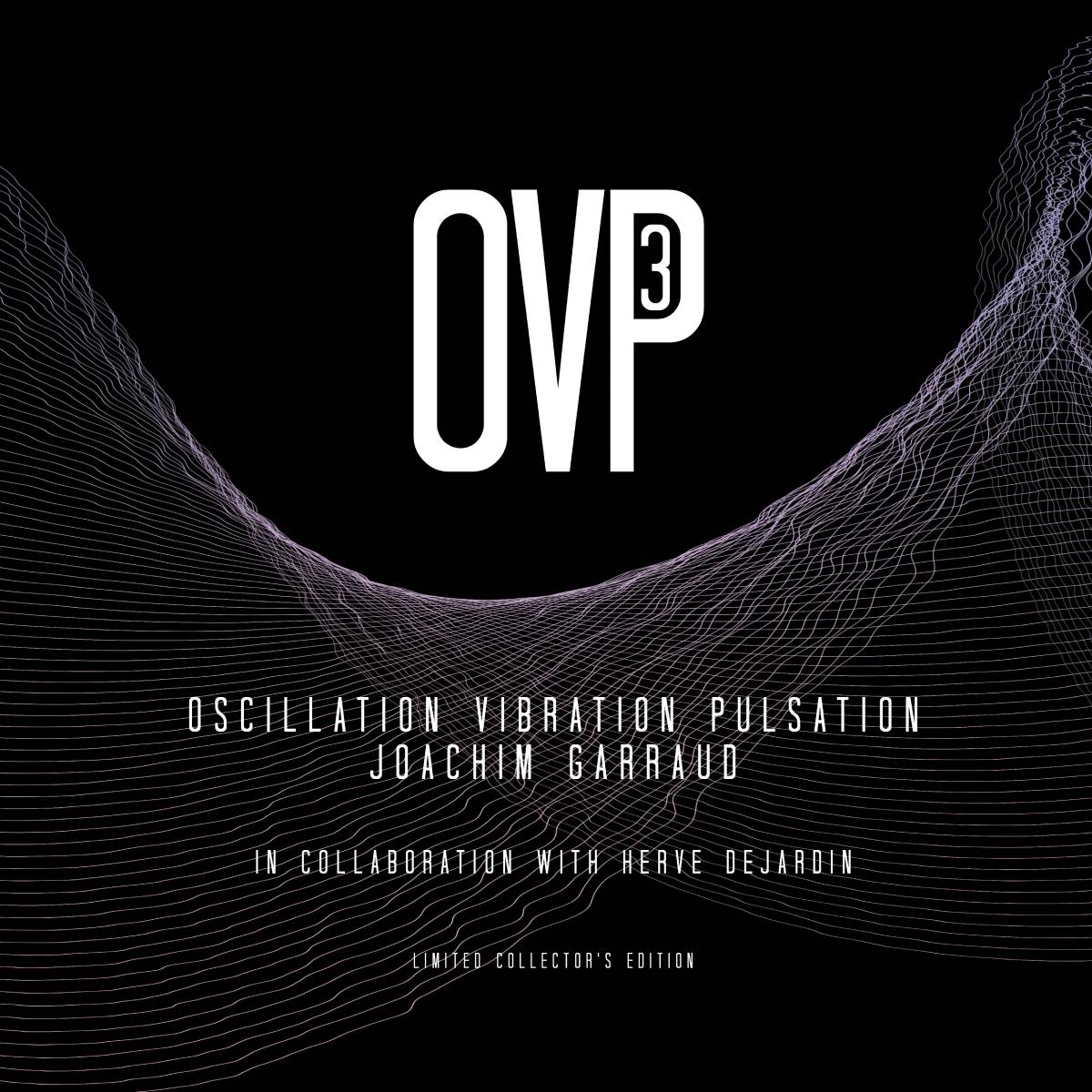
Oscillation, Vibration, and Pulsation: Shaping Sonic Universes Joachim Garraud’s OVP is a series of three albums that follow the classic three-act structure containing setup, confrontation, and climax/resolution. Garraud describes OVP’s narrative arc as an evolutionary process. “This trilogy is a summary of my entire creative path—from the solitary spark to the shared experience,” he writes. On his website, Garraud explains that he manipulates sound like “matière première,” or raw material. This language evokes images of sculptors and potters taking a formless substance and molding it into something that holds shape, purpose, and identity. This artistic philosophy is distinct in OVP, as Garraud uses sound design to develop immersive spaces throughout the narrative of his trilogy gradually.
OVP1: Garraud’s trilogy begins with Oscillation, representing the matière première of his sound. “OVP1 was really about introspection and isolation,” Garraud writes. “It was the ‘laboratory phase’: digging deep into my old hard drives, rediscovering raw sounds and samples in the solitude of the studio, and trying to make sense of my own sonic history.”
This album is surreal and intensely atmospheric, oscillating between tense moments of silence and collections of pulses and alien textures. Rhythmic, harmonic, and melodic progressions are used sparingly and strategically to balance cerebral patterns and visceral dynamics. Combined, these elements form a landscape of beginnings, grounded in raw material, the past, and Garraud’s internal experience.
OVP2: The second chapter of OVP represents Vibration, progressing the narrative through musical and emotional resonance. Garraud created OVP2 in collaboration with his son, Maxime, an instrumentalist, vocalist, and music arranger. “OVP2 was about opening up and creating a confrontation,” Garraud explains. “I invited Maxime into that laboratory to let his classical piano clash and converse with my electronic textures. It was a dialogue between the human touch and the machine, between tradition and the future.”
OVP2 extends the experimental sound design from OVP1 while developing a more complex melodic and harmonic palette. Garraud’s website describes this album as “plus apaisé,” giving way to “la mélancolie,” signaling that the raw materials of the first chapter have evolved into more articulated feelings of serenity and melancholy, pushing the narrative forward.
OVP3: The final chapter, Pulsation, brings the raw material and emotional resonance of chapters one and two into a fully manifested journey. “OVP3 represents maturity, accomplishment, and the expansion of that universe,” Garraud writes. “It creates a complete immersive space where sound, image, and environment come together.” Garraud constructed this album in the yawning landscapes of the American Southwest, producing each track using the L-ISA system from L-Acoustics to capture 3D, fully immersive audio. Accompanied by visual art by Greggy, the tracks blend prominent beats, harmonic progressions, and melodies, merging the tension between sound design and traditional music composition into a cohesive whole. The narrative culminates with the track “Bouquet Final,” grand finale that Garraud describes as an “explosion of life and performance.”
The final track of OVP3, “Alain Garraud,” acts as an epilogue, named in honor of Garraud’s father. Garraud sensitively describes this piece and his father’s influence on the album’s narrative as “the memory that stays alive, the eternal vibration that continues to resonate even when the stage lights go out. It is my tribute to his enduring influence; he is the silence and the peace that follows the noise.” Garraud uses silence, sound-mass, and narrative structure to capture the organic rhythms of lived experiences, challenging popular songwriting and production techniques. Composing in vast desert landscapes taught Garraud a crucial lesson as a producer. “Space is just as important as the notes,” Garraud writes. “You need to create ‘le vide’ (emptiness) to allow the sounds to exist, breathe, and resonate truly.” Garraud prioritizes meaning and flow over convention. Every pulse and vibration is treated with intention and given the space to develop, bringing the narrative to life.
The medium of sound design is uniquely equipped to tell stories like this. Sound can be stripped down to its most fundamental level with oscillators and expanded to create full sensorial landscapes using technology like L-ISA. The way Garraud shapes sound into narrative is masterful, transporting the listener on a journey that feels truly personal and saturated in a love for his work.
Types of Narrative and their Musical Application
Garraud’s organic subversion of typical musical structures invites us to consider other narrative styles that composers can use to continue the tradition of musical storytelling. There are three in particular—the circular, linear, and non-linear—that lend themselves well to the musical dimensions of lyricism, musical themes, and sound-mass.
Circular Narratives: The circular trajectory frequently appears in quest narratives like Tolkien’s The Hobbit, in which a protagonist literally goes “there and back again.” Circular narratives often convey universal themes and emphasize the protagonist’s growth (or lack thereof). In his article, Encarnação describes the foundation of a circular narrative as “the establishment of a stable home territory.” This structure unfolds naturally in music through chord progressions that begin and end with the tonic, arpeggios, and repeating rhythms. Additionally, circular narratives are a beautiful way to structure entire albums and performances, as they create a sense of satisfaction and conceptual depth.
Linear Narratives: In literature, a linear narrative tells a story in chronological order, describing the journey from one state or circumstance to another. This style is often used in creation myths, love stories, and tragedies that have a clear beginning, middle, and end. In a musical composition, this technique may look like chains of clever word associations, through-composition, progressive changes in rhythm and key signature, or the gradual building of musical intensity through instrumentation and dynamics.
Non-Linear Narratives: The opposite of the linear trajectory, non-linear narratives disrupt a story’s chronological progression, often using flashbacks or disregarding chronology altogether. Stories that use this technique are often introspective, mysterious, or uneasy, and they viscerally capture emotional states. Musically, composers could challenge the comforting predictability of music by changing the time signature, using atonal chord progressions, abruptly switching between genres, or employing arbitrary textures and dynamics to create uncertainty. In music and literature, the unpredictability of this structure is deeply atmospheric, prioritizing feeling over understanding and inviting listeners into the present moment.
Music and the Moment
In Garraud’s Artists of Sound feature, he explains, “I have something unique here. It’s the moment. The moment of a song.” This statement effortlessly captures what makes music so extraordinarily powerful. Through narrative, oscillation, vibration, and pulsation, music creates moments. It immerses us in the experience of other spaces and states of consciousness, cultivating connection and emotional intimacy.
Ultimately, when composing a piece of music, all the exciting narrative structures, musical themes, and compositional techniques are means to an end: capturing the moment so it can be shared. As musical tools and artists like Garraud continue to innovate, they create more ways for these moments to take shape.
Written by: Fiona Eirene
Subscribe to Our Newsletter
Get the lastest news and find out about listening events.