Beyond Visuals: How L-Acoustics and SCI-Arc Lead Spatial Audio for Architecture Beyond Visuals: How L-Acoustics and SCI-Arc Lead Spatial Audio for Architecture...
Spatial Audio for Architecture: SCI-Arc & L-Acoustics Partnership
As intelligent systems increasingly dictate how we navigate and perceive physical environments, designer and educator M. Casey Rehm is redefining the toolkit for the built environment. Spatial audio for architecture and immersive sound design are no longer secondary considerations; they are becoming foundational materials for shaping human behavior and interaction. Through his practice and his role in the MS Architectural Intelligence program at SCI-Arc, Rehm is establishing an architectural vernacular in which artificial intelligence, embedded technology, and spatial sound coalesce.
This year, that vision materialized through a collaboration between SCI‑Arc and L‑Acoustics. The partnership began not with the drawings typical of postgraduate programs, but with listening. What started as a seminar on spatial audio quickly became hands‑on experimentation in the L‑Acoustics demo room powered by L-ISA Immersive Sound, culminating in a public exhibition of interactive architectural prototypes.
A Home for Radical Practice: SCI-Arc’s Culture of Experimentation

SCI‑Arc has long blurred the boundary between practice and pedagogy. Founded on the idea that architectural education should be a laboratory for new ideas, the school attracts those whose work challenges convention and reframes what architecture can be. For M. Casey Rehm, who joined the faculty in 2014, the school provided an ideal laboratory to explore how sensing systems and interactive platforms become integral to architectural thinking
“SCI‑Arc is one of the few places where a program like ours could exist,” Rehm says. “The school was built on the idea that radical practice can and should shape pedagogy.” Over time, he helped evolve the MS Architectural Intelligence program from a speculation‑driven postgraduate studio into an applied-research platform focused on near‑term impact. The emphasis on experimentation, being fast‑paced, interdisciplinary, and hands‑on, set the stage for partnering with L‑Acoustics, and for treating sound not as an afterthought, but as a material that can shape behavior, guide movement, and define space.
From Seminar to Showcase: A Semester of Sound Play
The semester began with a listening brief. L-Acoustics’ Tim Boot demonstrated how spatial sound influences orientation and emotion. For a visual-first cohort, this was a paradigm shift; spatial audio for architecture moved from an afterthought to a primary design driver. “It was a lightning rod,” Rehm recalls. “A whole new set of brushes opened up for our students to paint with.”
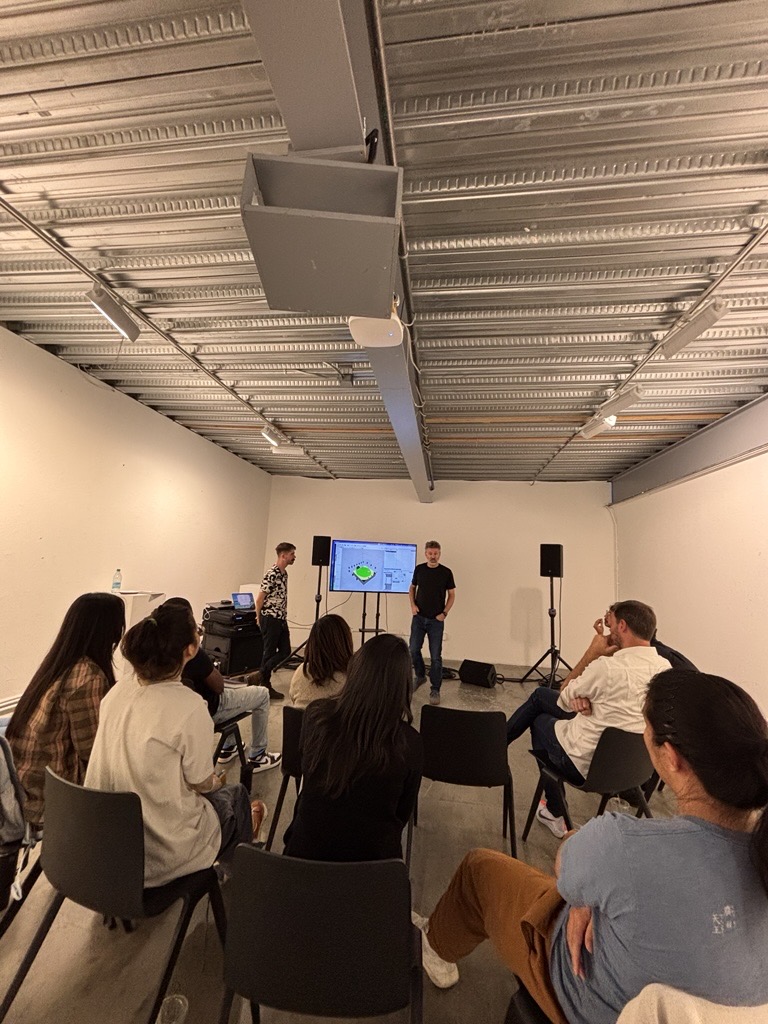
Students then moved to the L-Acoustics studio in Los Angeles for a visceral experience with L-ISA and Ambiance, an active acoustic technology. They observed how sound could possess weight and direction—gathering in a corner or sweeping overhead like a beam of light. Many described the sensation as “goosebump‑inducing.”
Back at SCI‑Arc, inspiration became practice. With guidance from the L‑Acoustics team, including quick tutorials and troubleshooting sessions with Applications Engineer Corbin White, students learned to shape the character of a room, let simple sensors trigger and modulate the sound, and weave those reactions into interactive installations. Students utilized Soundvision to visualize these soundscapes, demystifying complex workflows. “We went from knowing nothing to building interactive apps that controlled the spatial audio system within a semester,” Rehm notes. The studio rhythm shifted: alongside physical models, students sketched with interfaces and soundscapes.
A five-week sprint led to a public exhibition where the work finally met an audience. Each team presented a small environment in which physical structure, graphic interface, and carefully crafted sound worked together. Showing the projects live revealed what no laptop can: how a crowd changes perception, how a split‑second delay can blur the message, and how crucial it is that responsiveness be felt immediately. One installation that read clearly in the studio needed to be finetuned so visitors could sense its reaction within moments of stepping inside. Those real‑world adjustments are the lesson: interactive spaces must be legible, quick to communicate, and comfortable to inhabit. “You have to do it live to understand the complexity,” Rehm says. “With L‑Acoustics, students got to operate at a professional level on day one.”
Looking Ahead: Sound as Spatial Structure
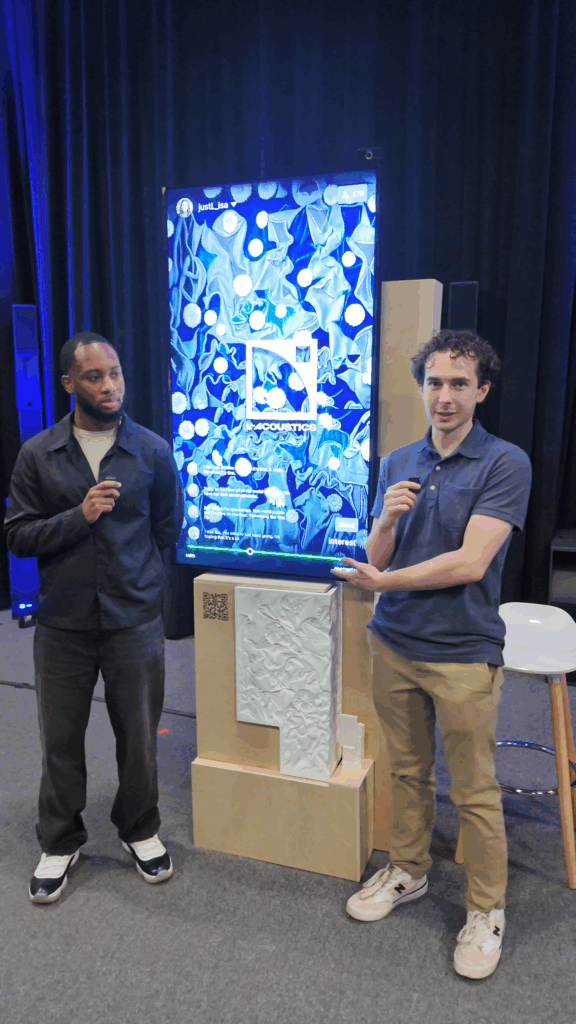
The SCI‑Arc × L‑Acoustics partnership widened the field of what architects consider design material. In responsive environments, sound functions like an interface: it directs attention, cues movement, signals behavior, and communicates what a space is doing. For these students, spatial audio shifted from a secondary to a main design driver in early proposals, accompanied by light, material, and form.
When asked how spatial audio technologies are changing architecture, Rehm returns to the question of what belongs in the discipline. Because today’s systems are so easy to prototype and refine, there’s little reason not to account for sound from the outset. He is particularly interested in how intelligent audio can organize space without ever moving a wall. With subtle shifts in sound, a building can suggest zones, guide flows, and create moments of intimacy or openness, drawing boundaries that remain as fluid as the life inside them.
Rehm envisions architects as the primary stewards of how AI and interactive technology inhabit physical space, with sound positioned as a core component of that integration. The MS Architectural Intelligence program focuses on an 18- to 24-month horizon—a “sweet spot” where research is far enough ahead to set a new direction, yet close enough to be technically deployable.
Within this framework, students learn to balance technical depth with concise communication, practicing how to articulate the essence of a complex, responsive project in under 30 seconds. Through the partnership with L-Acoustics, SCI-Arc is moving beyond speculation to prototype environments that listen, respond, and adapt in real time. As Rehm notes, “We’re exploring how architectural intelligence (sonic, visual, spatial) becomes part of daily life. And how architects can design with, and for, these new forms of technology.”
Subscribe to Our Newsletter
Get the lastest news and find out about listening events.