Women in Pro Audio: Jane Datony Women in Pro Audio: Jane Datony...
The live sound business operates like a heavy, unseen machine—loud, massive, and entirely reliant on the people behind the curtain to keep the gears turning. Yet, if you look behind the console, the demographic makeup of those pulling the levers still leans heavily in a single direction. Providing a spotlight for women in this space isn’t about lecturing the masses; it is a necessary course correction to reflect the actual talent keeping the tours moving, the feedback at bay, and the artists performing. Visibility normalizes reality. Without platforms showcasing the professionals who design, mix, and troubleshoot the loudest rooms on earth, the next generation might see the live circuit as a closed shop. Amplifying these voices matters because representation turns an anomaly into a standard. This month, we focus on Jane Datony, a monitor engineer who has navigated the chaotic, exhilarating world of touring to carve out a space entirely her own.
Finding a Home at the Console
Since 2014, Jane has built a formidable resume on the road. Her expertise has served artists like Lewis Capaldi, Joesef, Mount Kimbie, Rishab Sharma, Barry Can’t Swim, and The Last Dinner Party. As a monitor engineer, her job requires precision, intuition, and calm execution.
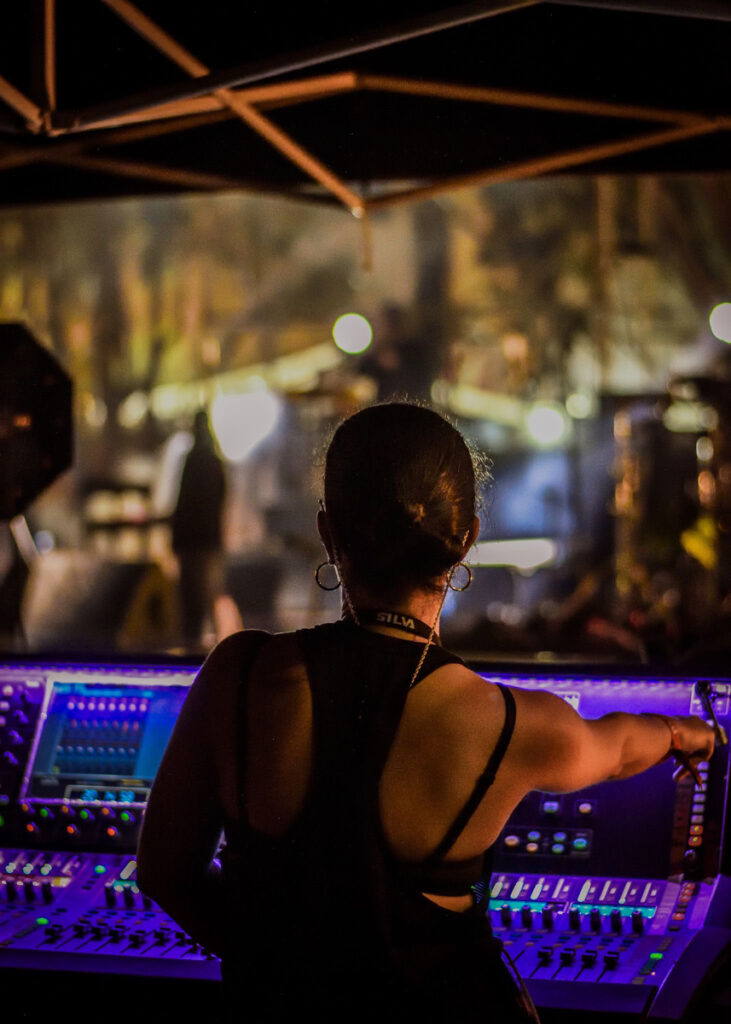
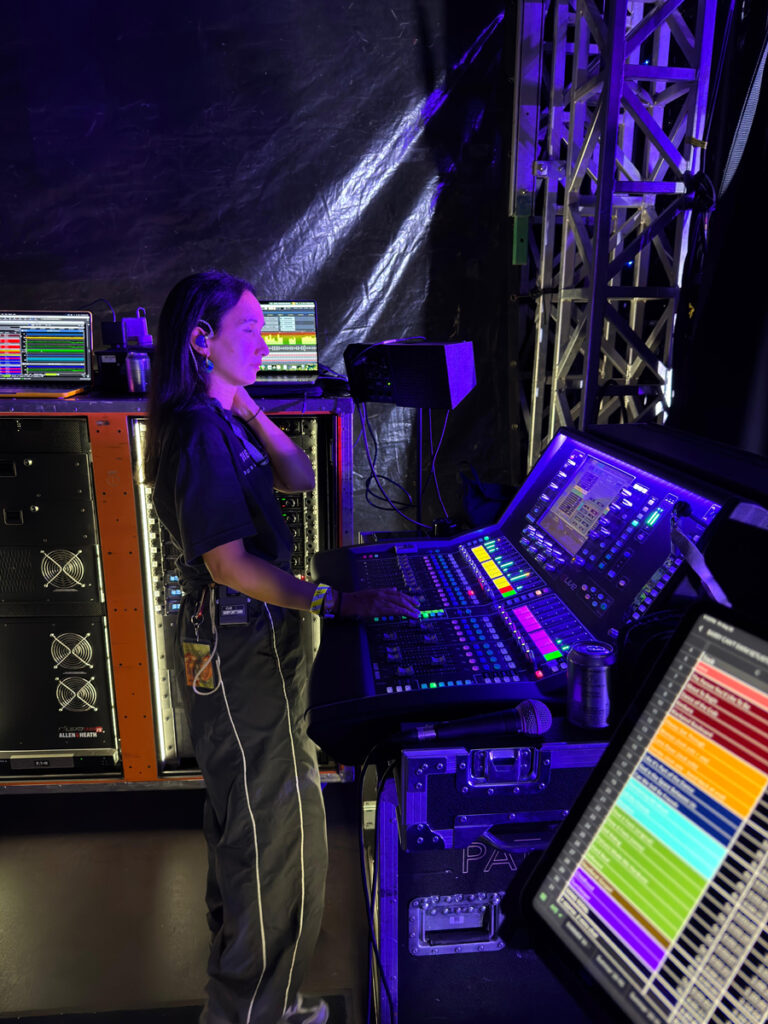
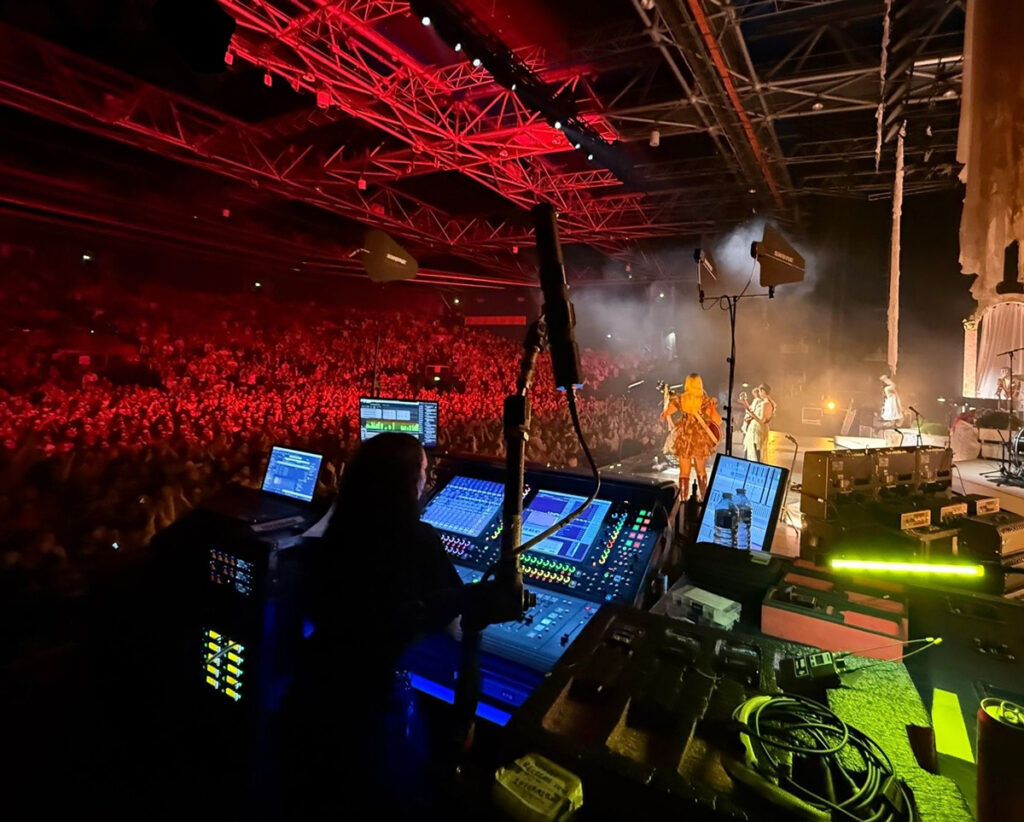
“These days you’ll usually find me behind the monitor console, bouncing around different corners of the world, currently with The Last Dinner Party, and recently wrapped up an adventurous year with Barry Can’t Swim,” Jane says. “I’ve made a home at the stage left end of the multi, where the heart of the audio system lives and feeds out to every direction it needs to reach. I’m in close proximity to the artist, where I can decipher their body language to determine how they’re feeling. My role is to make sure they each can hear what they need in their IEMs in order to perform comfortably, stay in time, and in tune. I also facilitate communication between the crew and band, keeping it flowing quietly in the background so we can all pull off a seamless show.”
An Unexpected Journey to the Stage
Jane’s path to the console was far from a straight line. Born in Bulgaria, she moved to the UK at the age of seven and has been based in Edinburgh since her university days.
“Breaking into the touring industry from there has come with its challenges and been a slow process,” she notes, then continues, “Compared to London, there’s limited access to the bigger production companies in the industry, the latest technology, and fewer opportunities to work alongside people operating at the highest levels. But it’s totally doable with a strong work ethic and a bit of persistence to seek out opportunities rather than waiting for them to come to you.”
Her initial interests skewed heavily toward the artistic rather than the engineering side of production. “When I was younger, I honestly didn’t even know what a sound engineer was. It was never presented as a career option at school, and there weren’t really any subjects that touched on it,” she explains. “My mum was musically trained and very creatively driven, so I naturally gravitated towards creative subjects. She taught me piano from a young age, and I picked up guitar along the way. It always felt likely that I’d end up somewhere in music, art, or literature—but I was wary of the instability associated with those paths, and I never felt comfortable being the one in the spotlight. After finishing school, I still had very little understanding of real-world career paths. A friend mentioned a sound production and audio engineering course, and I enrolled almost on a whim—that was really my first introduction to the technical side of the music industry. It was meant to be a temporary step while I figured things out, but once I got into it, I got hooked. I can be quite stubborn, so I stuck with it—and that decision ended up shaping my entire career.”
Her classroom experience provided an early, stark look at the demographics of her chosen field. “At the time, I had no awareness of the gender imbalance in the industry. I remember my naivety during my interview when a lecturer mentioned they were keen to enroll more women—it didn’t really register then, until the course began. I was one of four women to start, and by the fourth year, the only one left.”
Her entrance into the live environment required a leap of faith from the studio. “I originally trained in studio engineering. There was a small live sound module, but it was limited, and at the time I had no real intention of moving into live work—I was much more comfortable in the studio environment. That changed when a few work experience opportunities came up, and I found myself stepping into the live world. I started out in small venues in Edinburgh, cutting my teeth with analog desks and outboard gear in subpar, challenging environments. It was very much a baptism of fire, but I was lucky to have some really supportive mentors who are now my colleagues. They took a chance on me and pushed me to grow when I had no confidence.”
To establish financial stability, Jane took a part-time job as a sound technician at Edinburgh College for many years until she felt confident enough to sustain herself as fully self-employed. “As I gained experience, I became a regular across local venues and festivals, which helped me build both my skills and meet so many people, which built my network,” Jane adds. “I eventually crossed paths with some of the very few larger production companies in Scotland, and someone felt it worthwhile to give me an opportunity, and thus the doors into the touring world were opened. Breaking into the touring circuit took me six-plus years. It’s a small, close-knit world, and getting that first opportunity can be difficult, but once I got a foot in the door, things began to build much more quickly. Now, through touring, I’ve connected with major production suppliers in both the UK and the US. What once felt like a limitation—being based in Edinburgh—is no longer really a barrier.”
Championing Women in Pro Audio
Navigating the unique hurdles of a male-dominated field remains a defining aspect of her experience, forcing her to confront internal and external expectations.
“One of the biggest challenges I’ve faced is feeling like I didn’t have permission to learn. No one starts out as an expert—we all gain experience over time—but when I was starting out, every mistake felt amplified,” she says. “It felt as though I was representing women as a whole, and that any gap in my knowledge might be attributed to my gender rather than simply inexperience. The confidence that came with becoming more experienced is something I’m still catching up with. I sometimes still find myself second-guessing my instincts, especially in situations where a less experienced colleague may speak with more certainty.”
Personal expression on the job was another hurdle she eventually overcame. “For a long time, I also tried to de-feminize myself to fit in around big, bearded lads. These days, I’m far more relaxed about how I dress at work. If I’m on a hot, sweaty European summer festival site, I will wear shorts and a crop top. If I feel like wearing makeup some days, I will. You can wear eyeliner, and it won’t detract from your technical ability!”
Women in Pro Audio: The Diversity Quota
Jane is highly aware of the complex realities surrounding diversity initiatives. “There came a turning point in my career where being a woman started to work in my favor. The industry places more emphasis on diversity these days, and while that shift is positive, it can also create a different kind of doubt—questioning whether opportunities are based on merit or simply fulfilling a quota. It’s important for those hiring to approach diversity thoughtfully. Expanding the talent pool is essential, but we must put people into appropriate roles. Otherwise, there’s a risk of setting them up to fail, which only reinforces the very stereotypes we’re trying to dismantle.”
When examining the underlying reasons for the scarcity of women in audio engineering, Jane points to entrenched historical biases and structural failings. “Lack of representation causes us to internalize ideas of what we can and cannot do. Traditionally, it was seen as too physical and technical a job for women who were supposed to stay home, and those outdated norms are hard to shake. Not to mention that many of the women who do get into the industry and become successful eventually have to choose between motherhood and career. This phenomenon isn’t unique to our industry, but it’s particularly challenging, if not almost impossible, when touring. If the industry did more to support it, we could retain more of the female workforce.”
For other women aiming to break into the industry, Jane’s advice is straightforward. “Not being afraid to ask questions is a really refreshing approach in an industry where no one wants to show weakness. Go to your local venue and ask if you can shadow and observe, or call your local production companies. You’ll find people who are willing to support you—you may have to take some leaps of faith, but they’ll be worth it. Use resources like Women in Live Music to connect with others and find workshops and training opportunities.”
Troubleshooting and Finding Resources
To excel in such a high-stakes environment, continuous education and a grounded mindset are mandatory. Jane relies on a methodical approach to crisis management.
“I approach technical challenges by slowing down, going back to the basics, and troubleshooting along the signal path,” she explains. “This gives me the best chance to approach the problem with a clear head. If I need help, I always have a few people I can rely on, or I check YouTube or the manuals. Don’t let pride get in the way!”
Her toolkit for career growth is expansive. “I regularly use the Shure education portal and the RF Venue website; they have fantastic training materials for the world of RF. Dante also has certifications you can take to strengthen your networking knowledge. All the major equipment manufacturers have video tutorials on YouTube. I admit that reading manuals is a bit tedious, but it is worth it when you need to go in-depth with a new piece of kit. Production companies also often host workshops, which are a great way to get hands-on with new gear and stay in touch with colleagues at the same time.”
Jane credits specialized organizations and rigorous instructors for broadening her horizons. “Women in Live Music has been an invaluable resource to me that has widened my horizons. I attended some of their training seminars. If you’re interested in systems design and engineering, this is often an area where it’s harder to gain experience. Kim Watson is the UK Rational Acoustics SMAART instructor and runs regular short courses. Education is just as essential as hands-on experience; without theory, you can end up using tools by habit or imitation without understanding why something works. The hands-on experience turns that theoretical foundation into good engineering.”
When identifying the most critical traits for long-term success, Jane highlights three specific areas. “The biggest skill that has driven my career forward is paying attention to detail. Being prepared, spotting potential issues before they arise, and staying one step ahead instead of scrambling around on the job makes a huge difference in the live environment where things move quickly and there’s little room for error,” she notes. “Alongside that, the ability to stay calm under pressure is invaluable. This industry is fast-paced and unpredictable, and staying level-headed helps you make better decisions and reassures the people around you. That sense of calm can really shape how a team functions in high-stress moments. Finally, being a nice person to be around goes a long way. Touring means spending long periods in close quarters and facing challenges together. And I don’t mean you need to be the life of the party, but being respectful, approachable, and easy to get along with can be just as important as technical ability in building long-term working relationships.”
Unforgettable Moments on the Road
The reality of touring is a volatile mix of breathtaking milestones, logistical nightmares, and outright absurdity. Jane cites being part of Barry Can’t Swim’s All Points East headline show as a major highlight, where the inclusion of a 13-piece string section, brass, and guest performers posed a unique challenge in designing the dual-monitor system.
However, the chaotic stories are often the most memorable. “So many crazy things happen in this job; I feel like most of them aren’t appropriate to share!” Jane laughs. “I was on tour with Rishab Sharma last autumn. His sitar, handcrafted by his father, is incredibly precious. It usually travels with its own seat, but on the first flight, we couldn’t get a ticket for it, so he had to check it in. As luck would have it, it got lost! We had a spare on the truck for the show, but this instrument was irreplaceable, and his family was traveling with us—everyone was in despair. Rishab took to social media and, through his network, connected with someone who worked in baggage reclaim at London Heathrow. They located the sitar for him and forwarded it on! The stars aligned on that one! And now we have someone on the inside. By the way, AirTags are your best friend when touring!”
Other scenarios have tested her nerves and endurance far more intensely. “A couple of years back, at a festival in India, a band on our stage got electrocuted halfway through their set. They paused for twenty minutes, tested the power, and then continued the set! It definitely left everyone feeling a bit shaky that night,” Jane recalls. “A good while back, on a support tour, I had to set up my monitor console on a substack! It was the smallest venue on the tour, and the headliner’s package barely fit. Luckily, I was carrying a tiny SD11 and was able to maneuver into some compromising positions. I asked my FOH to take it easy on the subs that day!”
The Reward and the Future
Despite the ever-changing hours of life on the road when touring, the profound pull of live music makes the hurdles worthwhile.
“It’s my gateway to climbing the world’s most beautiful peaks and eating the world’s best food! I’m interested in social anthropology and love having the opportunity to travel the world and observe how people think, live, and organize themselves. It’s been so rewarding for me to combine my love of music and exploring different cultures,” she shares. “The variety of the job keeps my mind motivated, active, and curious. Working with people from all over the planet has also been very enriching, broadening my views. We build unique relationships in this industry because we face unconventional challenges together, and we end up creating bonds that don’t resemble how an ordinary friendship develops. It’s simultaneously also a challenge for me, as I’m naturally an introverted person, and it doesn’t come easily meeting so many new people all the time.”
The ultimate payoff happens when the house lights go down. “I love being part of the musical creative process and the exchange of energy that happens in a room of thousands of people all united for that moment. It transcends our differences, and I do believe that music has the power to heal,” Jane says. “There’s an incredible documentary called ‘Scream for Me Sarajevo’ about a rock concert played in a warzone in the 90s. It’s a powerful portrayal of what music can do for people in their bleakest moments—a form of resistance and emotional survival.”
She continues, “Career highlights include touring with Mount Kimbie on their Sunset Violent album, whose music I connected with deeply, and doing the Lollapalooza circuit in South America and Fuji Rock in Japan with Barry Can’t Swim. When I worked for Lewis Capaldi as an audio tech, we were once third from the top on the Rock Werchter main stage with Metallica headlining—sharing a stage with them was a thrill after spending so much of my youth listening to them.”
Looking Toward the Future of Live Sound
Looking ahead, Jane hopes the industry addresses its inherent instability. “I would like to see the lack of formality in employment addressed. As freelancers, we are vulnerable and unprotected—there is no sick pay, and tours can ‘confirm or cancel’ on a whim. It creates an unhealthy environment. I’d like to see more tours encourage crew to take time off if they need to and put in a dep without fear of losing their place on the team. Some gigs have contracts and NDAs; others can be confirmed with as little as a verbal agreement. Always get confirmations in writing and discuss rates and terms, like cancellation policies, at the onset.”
Jane also recognizes a positive shift in how tours operate, a trend she hopes becomes standard practice. “I’m also seeing more emphasis on wellness on tour, both mental and physical. Prioritizing sleep and eating well all contribute to longevity in the industry—I’d like to see this continue. I’m lucky enough to have worked with many bands that cultivate a healthy ethos around this. For example, The Last Dinner Party, with whom I’m currently working, provides their touring crew with access to mental health therapists. I’d generally like to see the industry become a better place for everyone, which we can all play our part in by advocating for fairer conditions and practices that support a better work-life balance. This way, I hope we can move away from inevitable burnout and instead move towards longevity in this career.”
Keep up with Jane’s work by following her on Instagram at @jdatony.
To read last month’s Women in Pro Audio interview, click here.
Would you or someone you know like to be featured in our Women in Pro Audio series?
Subscribe to Our Newsletter
Get the lastest news and find out about listening events.