Kevin Pollard’s Acoustic Fields: Inhabiting Sound Kevin Pollard’s Acoustic Fields: Inhabiting Sound...
There’s a famous quote that’s usually attributed to Jean-Michel Basquiat. “Art is how we decorate space,” the artist (might have) said. “Music is how we decorate time.”
The work of Kevin Pollard, though, seems to challenge this claim. “I think that quote is beautifully true, but maybe incomplete,” says the composer behind London’s innovative new installation Acoustic Fields. “We don’t experience space without time, or music without space. The most interesting moments happen when those boundaries overlap. And as everything is merging, the answer is evolving.”
Born in Brussels and based in London, Pollard trained as an architect at Newcastle University and spent a decade practicing as an architect. But he has also played the piano since he was four years old and has shifted his professional focus to music—composing, producing, playing on sessions, and creating film scores and commercial themes for clients such as Microsoft, Jaguar Land Rover, and Adidas.
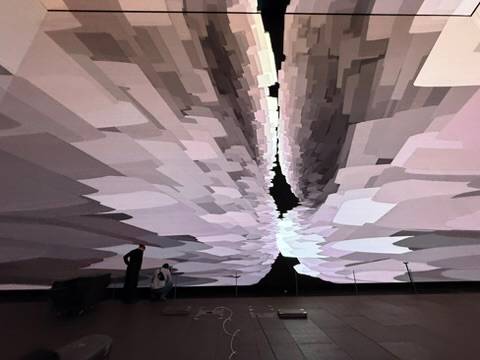
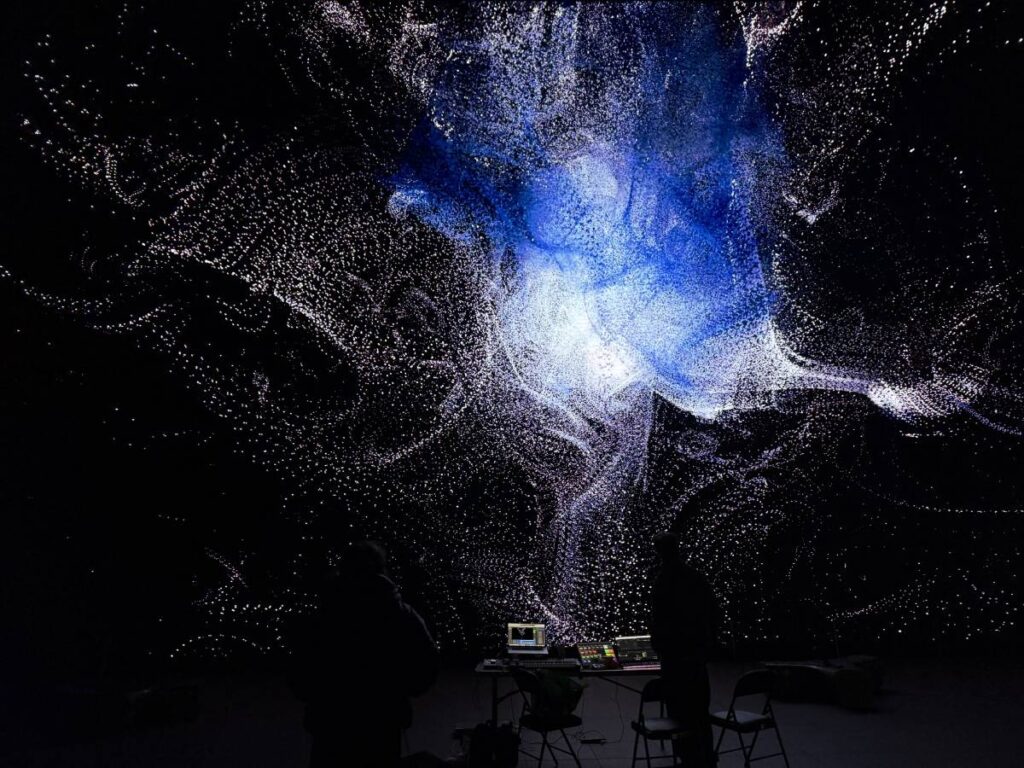
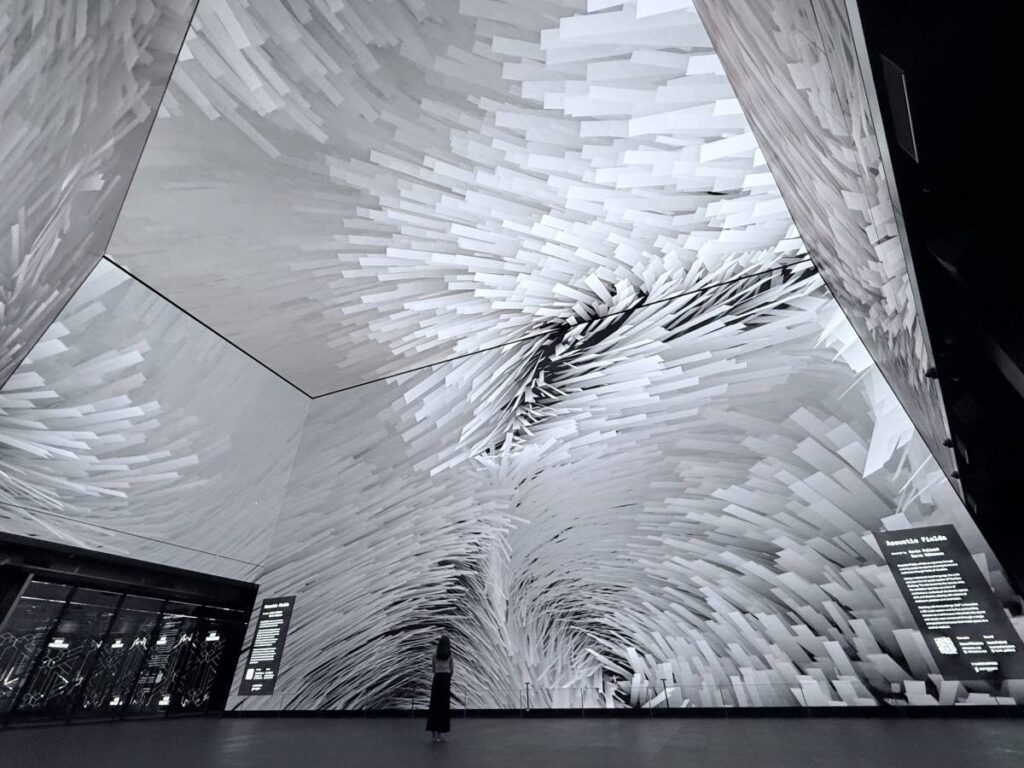
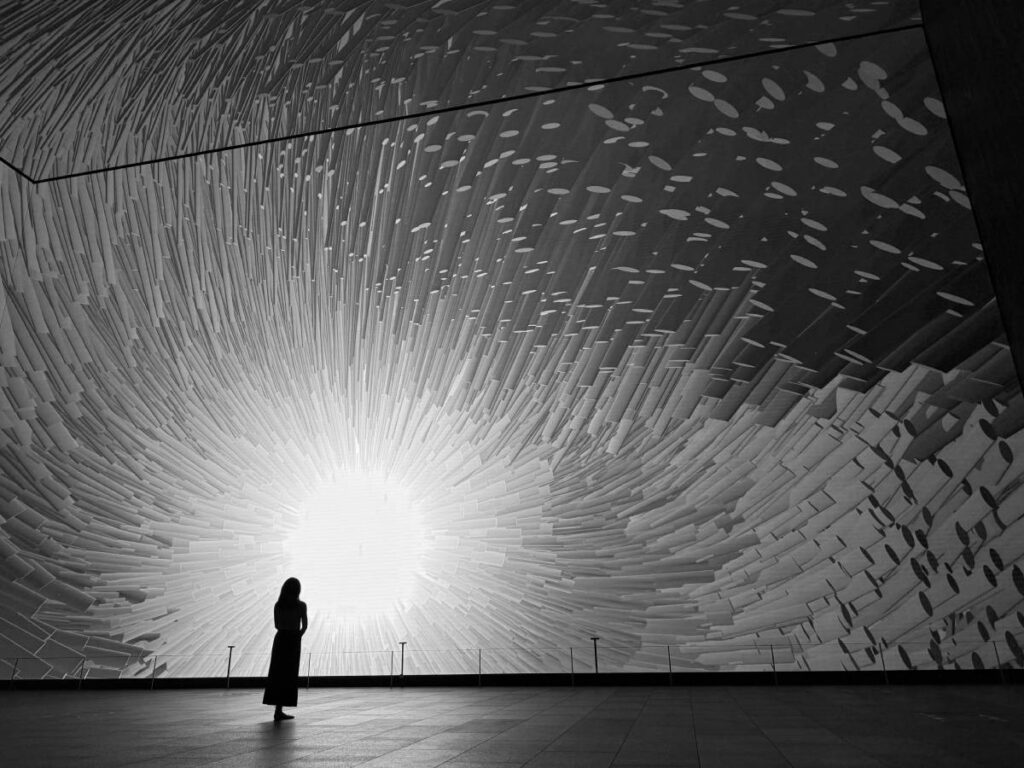
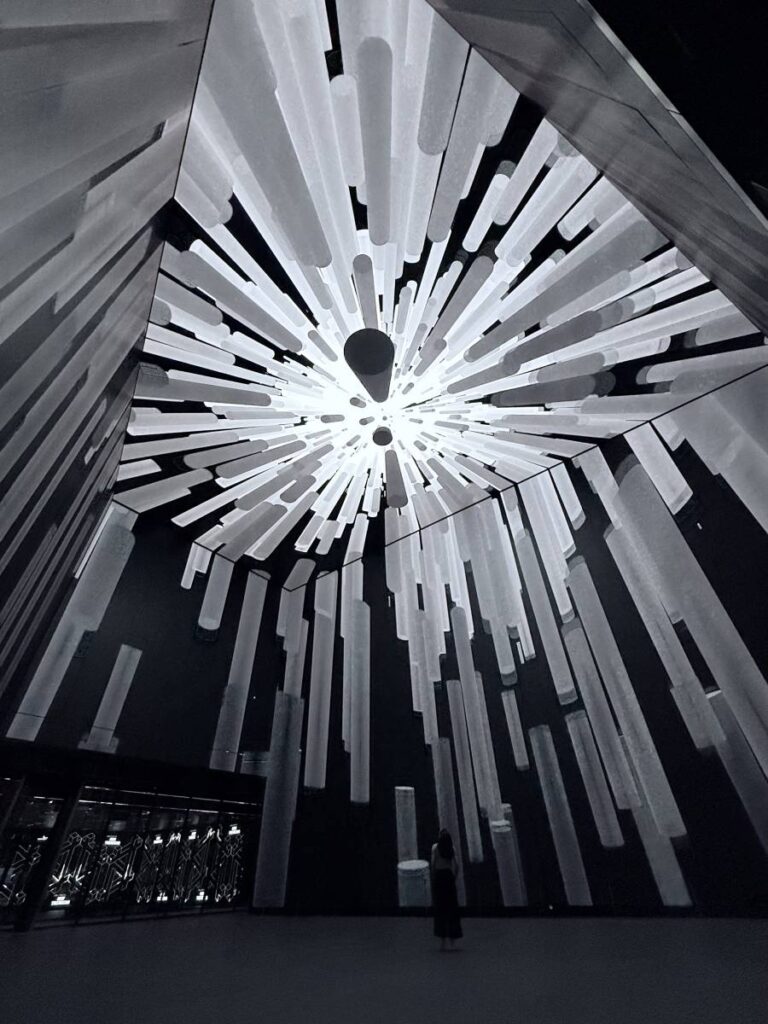
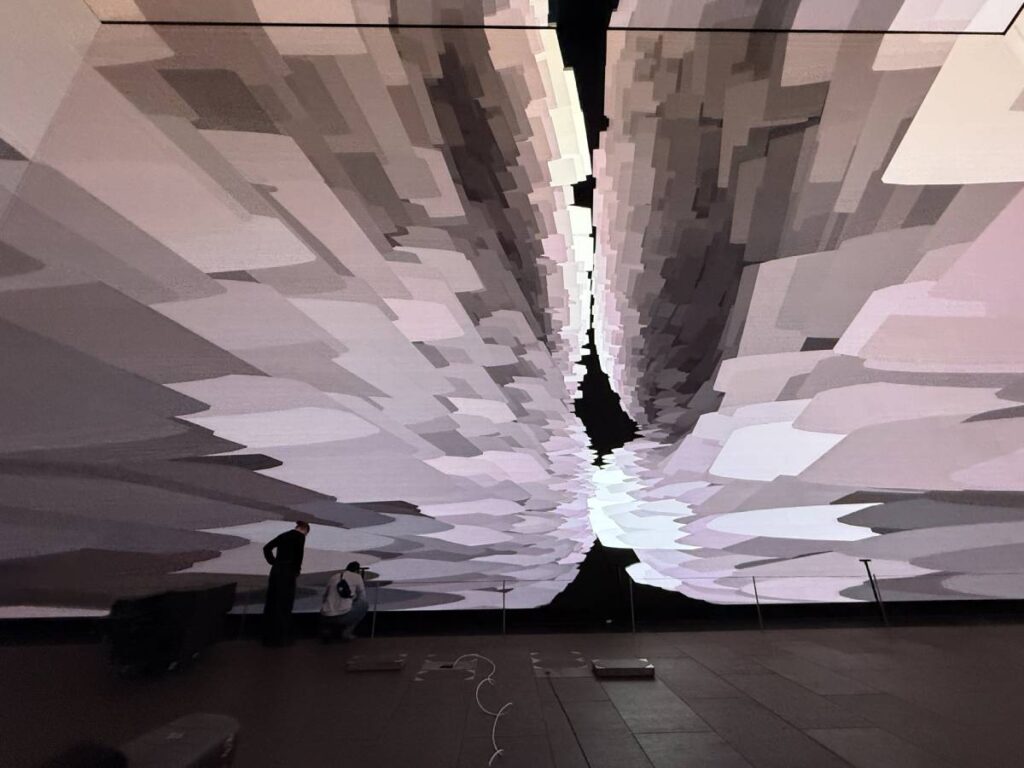
Most intriguing is how Pollard merges his passions into sound design for site-specific projects like Acoustic Fields. The installation currently resides at the NOW Building—a giant public atrium clad in LED screens—within the Outernet London entertainment district.
“I was brought in to help create a piece for the space that stretched it, utilized its full capabilities, to explore and show what a format like this could offer if thought of from the ground up,” he says. “It evolved into an attempt to treat the building itself as part of the instrument.”
Working with the building’s 360° L-Acoustics L-ISA audio system and its five surrounding screens, Pollard developed the piece in close collaboration with Savva Mihaescu, with Pollard developing the music, sound and spatial composition, and Mihaescu developing the visual language and coding the real-time visuals.
“Like a film or ad, you want something that’s captivating within the first 5% of the piece,” he says, “but we were keen to avoid making something that behaved like a screensaver or a digital firework—great for 10 seconds, enough for TikTok and Instagram, but then nothing new really happens. Like with any artwork, you want to give people a reason to keep investing their time and attention.”

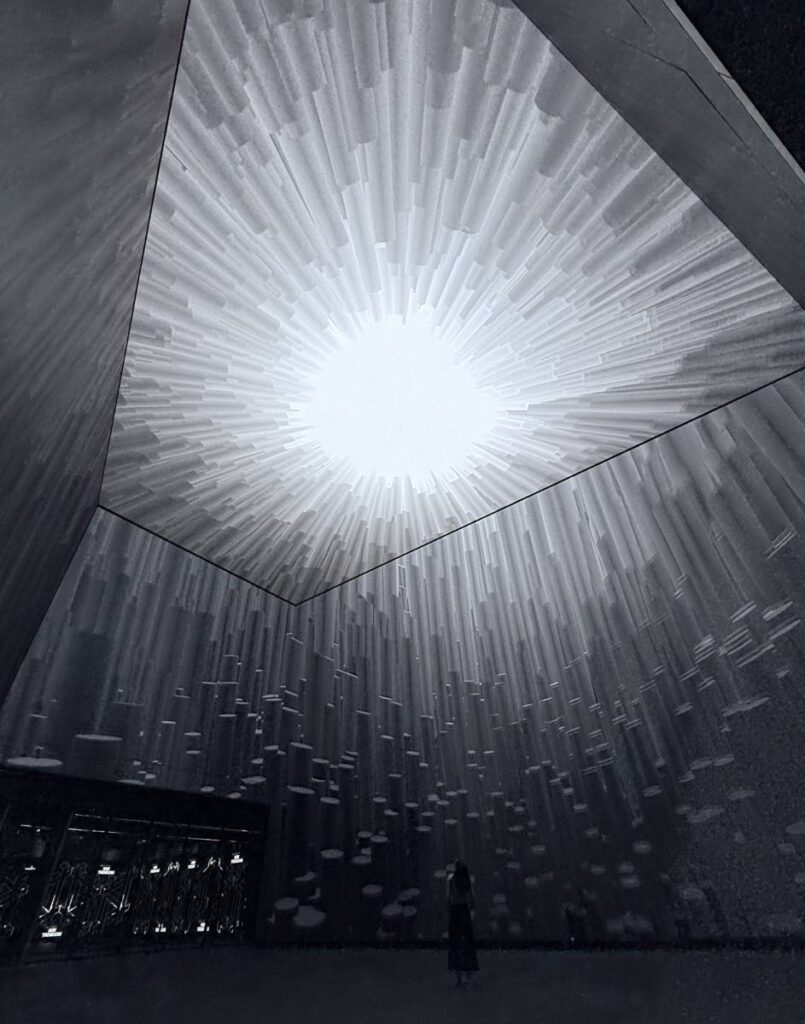
Achieving this holistic feel, the consistency that Pollard refers to as “oneness,” required a delicate balancing act that took all aspects of the project into account. “If the visuals dominate, then it’s more like a film score,” he says. “If the sound dominates, it’s more like a music video. If it was too fast, then all the precision disappears, and it’s a blurry mess. Too slow, then it drags or gets lost in the hubbub. So the sound, visuals, and space developed together as one conversation.”
This led to a simplified overall approach to Acoustic Fields. “Lines and dots became the visual syntax we developed for the piece,” says Pollard. “It’s an abstract journey through space and enclosure where the space provides the lens but is also an instrument in itself because you are in it.” Working with the building and its location also meant allowing for traffic noise, visitor conversations, and the long reverb of big rooms—the final mix, he points out, “is shaped to work with the characteristics of the NOW Building rather than fighting them.”
Pollard’s architecture training obviously factors into his composing. “Architecture taught me to think less about objects and more about relationships—between materials, people, movement, light, and emotion,” he says. “I think I carried that into music. Whether designing a building or composing a score, I’m interested in how separate elements combine into one experience.”
But he also cites a very different inspirational experience as a great influence on his work—the first stadium concert he attended, Michael Jackson at Wembley Stadium, and how MJ collapsed the distance between artist and audience. “He realized that to keep his mega shows coherent he also needed to guide focus,” he says. “The glove, the white socks, the fedora, all became devices not just on stage but through the whole work. It was an early masterclass in how to build multi-dimensional experiences.”
On the heels of Acoustic Fields, Pollard is working on a variety of projects, including an immersive piece featuring a dancer “modulating what I’m playing with her movements, like a new type of lead singer,” and an immersive recording of his father reading his favorite children’s story.
“I think music is expanding from something we listen to into something we inhabit,” he says. “As technology dissolves boundaries between disciplines, the most exciting opportunities may come from composers, artists, architects, coders, and audiences creating experiences together.” He points to the ways concerts already extend beyond the stage, highlighting the importance of merch and audience interactions, which “keep the conversation going” (think Taylor Swift’s friendship bracelets).
“It feels that music will become a part of these bigger experiences rather than the main focus,” he says. “I mean, it could be the main focus, but it will have more around it.” The limitation is the cost of creating experiences that can only be performed a few times. Still, Pollard expects that “more creative ways of being able to create amazing experiences with smaller teams and lighter footprints will be the main area of innovation over the next few years.
“The musical moments we all cherish the most involve a place,” he adds. “There’s a ‘scene,’ and the scene normally comprises multiple art forms. We just didn’t attribute the same importance to those other parts as we are starting to do now.”
Written by Alan Light.
Subscribe to Our Newsletter
Get the lastest news and find out about listening events.