Deep Dive: The Active Acoustics of the L‑Acoustics Ambiance System Deep Dive: The Active Acoustics of the L‑Acoustics Ambiance System...
A room’s physical dimensions ultimately dictate its acoustic boundaries. While variable passive acoustics, such as curtains and custom panels, excel at absorbing energy and reducing reverberation for drier sound profiles, they cannot add physical volume or increase reverberation in a constrained space. When a venue’s natural reverberation is too limited for a specific performance, the auditory experience falls flat. L-Acoustics Ambiance serves as a complementary active acoustic solution to passive acoustics, increasing reverberation to expand a space’s acoustic possibilities rather than replacing traditional treatment.
A contemporary performance might require a dry acoustic environment, matching the natural acoustics of the room. However, that same room would be far too dry for classical music. As an advanced, standalone active acoustic system, Ambiance captures a venue’s existing acoustic energy, processes it, and redistributes the enhanced audio through a dedicated loudspeaker configuration. By increasing the reverberation to a precisely crafted sonic signature, the system creates the auditory sensation of a corrected or much larger space, making both artists and audiences feel they are enveloped in a grander environment. It gives venue owners the flexibility to welcome a wide variety of show genres and instantly sculpt a room’s acoustic identity to suit diverse programming, securing long-term operational flexibility without altering the physical architecture.
The Architecture of Ambiance
Ambiance functions through a precise loop of capture, processing, and amplification. High-quality room microphones are strategically distributed across the venue to capture the natural acoustic energy produced by the performers and the audience. These microphone signals travel via a digital audio network to P1 Milan-AVB processors and feed directly into the Room Engine housed within the L-ISA Processor II Core. Once calibrated by an L-Acoustics specialist, the DSP ecosystem makes it possible to add the exact reverberation needed for the day’s performance. Finally, the modified acoustic signal is distributed back into the room through an overhead canopy of loudspeakers. This extends the reverberation time and modifies the room’s character while preserving its naturalness.
A crucial step in this integration is the “voicing” of the system. Integrators and acoustic engineers spend dedicated time directly with venue owners, local musicians, and conductors to co-build the system’s distinct sonic signatures. This hands-on, collaborative process can take several days to perfect, ultimately delivering four or more bespoke acoustic possibilities tailored precisely to the room’s architecture and performance needs. With a simple remote interface or preset control, audio teams and non-technical users can instantly toggle these signatures to suit the specific demands of any event.
Bridging the Rehearsal Gap
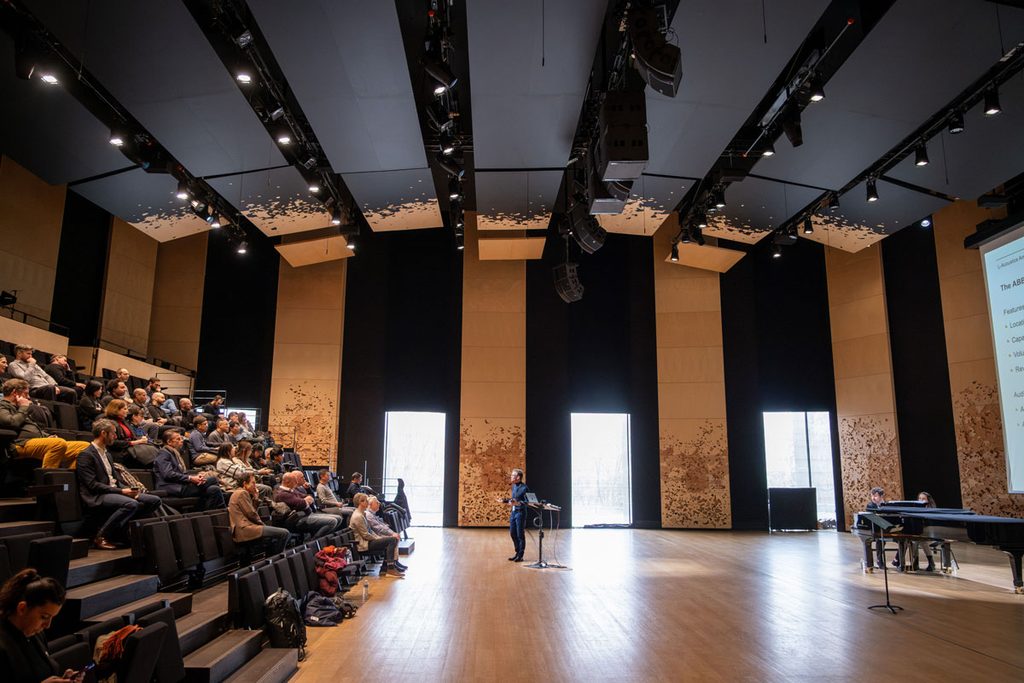
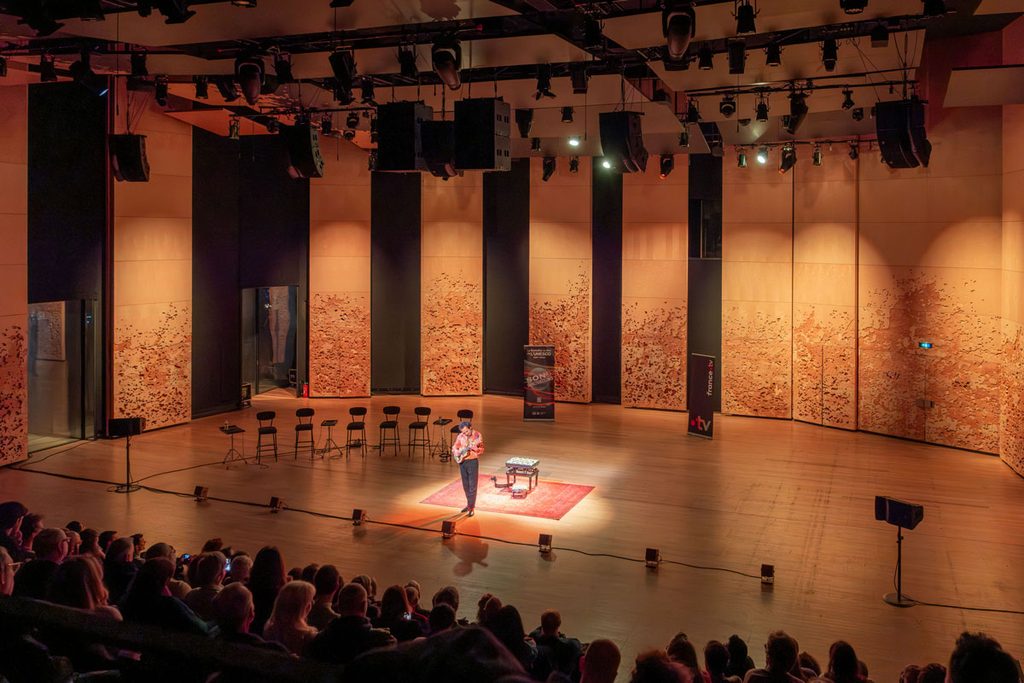
At the Philharmonie de Paris, Le Studio serves as a 208-seat rehearsal space with a natural reverberation time ranging from 1.1 to 1.3 seconds. By comparison, the venue’s Grande Salle reaches up to 3.1 seconds. To offer musicians the possibility to rehearse in an acoustic environment similar to the Grande Salle, the venue integrated 16 Schoeps MK21 wide cardioid room microphones, 20 L-Acoustics X8i overhead speakers, one L-ISA Processor II, and four P1 Milan-AVB processors. Ambiance offers four stepped acoustic signatures, ranging from the room’s natural short reverberation to one comparable to the Grande Salle. The result immediately elevates the player’s experience.
“With Ambiance, switching the room acoustics by a press of a button gives musicians the ability to outperform,” notes the Philharmonie team. “It makes it possible to offer premium acoustics to any world-class artist we welcome here.”
Preserving Heritage Architecture
Historic venues carry strict preservation mandates. The Poznań Opera House is a 110-year-old, 900-capacity theater in Poland where architectural modifications are explicitly forbidden. The integration team discreetly hid 11 small microphones in the ceiling, mounting three directly into the massive chandelier. Ambiance feeds the captured audio back through 20 hidden speakers, adding necessary reverberation. The room instantly adapts from speech and amplified pop music to chamber orchestras and philharmonic music, scaling up the reverberation while keeping its historical integrity intact.
“We’ve chosen to adopt modern technology that allows the theatre’s audio engineers to ‘sculpt’ the orchestra’s sound to ensure a consistent and immersive audio experience for the entire audience,” comments Sylwester Wojcieszek, Director of the Audio Plus design department.


Tracking Three-Dimensional Movement
In China’s Anhui Province, the 1,320-seat Anhui Bai Xi Cheng Acrobatic Theatre demands spatial sound localization that matches acrobats moving dynamically through space. The venue paired L-ISA Hyperreal sound with an Ambiance system, utilizing 24 microphones to capture spatial acoustic energy. Real-time tracking transmits six-dimensional positional data to the L-ISA system via the network, allowing the audio to track the performer’s trajectory precisely. Ambiance lets the house team instantly toggle reverberation from dry, intimate spoken theater to lush, reverberant musical productions at the touch of a button.
“By designing and optimizing a multi-channel system that applies L-ISA Hyperreal and Ambiance together, we’ve achieved a level of control over acoustics and spatial audio that wasn’t previously possible in this type of venue,” concludes house Sound Engineer Cui Yangkang.

The L-Acoustics Advantage
Modern performance spaces rarely have the luxury of catering to a single genre. Venues demand adaptable acoustic signatures to transition seamlessly from intimate spoken-word theater to expansive symphonic arrangements, and they cannot achieve this with passive acoustic treatments alone. Ambiance delivers this operational flexibility instantly, preserving the architectural design of historic halls, the capital budgets of new builds, and the artistic intent of every production. Beyond solving spatial limitations, the system’s capabilities are so robust that clients increasingly see its potential for purely creative applications. Ambitious projects like Dataland, where Ambiance directly serves the artistic narrative, prove that the true L-Acoustics advantage lies in this boundless versatility, ensuring the physical room and the sonic experience work in total harmony.
What is the L-Acoustics Ambiance system?
It is an active acoustic solution that captures a room’s existing energy, processes the audio through an L-ISA Processor II Core, and redistributes it via an overhead loudspeaker configuration. This effectively increases reverberation to make a physical space sound larger.
How does active acoustics differ from passive acoustic treatment?
Passive treatments like curtains, custom panels, and baffles soak up energy to dry out a room. Active systems operate in reverse, injecting calculated reverberation into the environment to expand a venue’s natural acoustic boundaries.
Can Ambiance be installed in historic buildings?
Yes. Integrators can discreetly embed the necessary microphones, processors, and overhead speakers into existing architecture. This preserves a venue’s historical integrity while entirely upgrading its acoustic flexibility.
How do venue operators control the system?
Users operate a simple remote interface to toggle between distinct acoustic signatures. These presets are co-built by integrators, acoustic engineers, and local musicians during the initial system tuning.
What equipment drives an Ambiance system?
The architecture relies on high-quality room microphones, P1 Milan-AVB processors, the Room Engine housed within an L-ISA Processor II, and an overhead canopy of L-Acoustics loudspeakers.
Does Ambiance support spatial audio tracking?
Yes. When paired with an L-ISA system utilizing L-ISA Hyperreal sound, the setup can receive real-time positional data to match acoustic energy with a performer’s dynamic trajectory through a venue.
How does active acoustics benefit rehearsal spaces?
It allows musicians to practice in a sonic environment that mirrors a main performance hall. By instantly extending the reverberation time, players experience the acoustic signature of a grander room, elevating their preparation long before show day.
Subscribe to Our Newsletter
Get the lastest news and find out about listening events.