The Sound of a Glacier Melting: Madame Gandhi’s Use of Spatial Audio as a Tool for Environmental Advocacy The Sound of a Glacier Melting: Madame Gandhi’s Use of Spatial Audio as a Tool f...
Spatial audio has always drawn from the natural world. It simulates how we typically experience sound by playing with depth, layering, and enveloping us. The result is a listening experience that is both familiar and moving. It’s fitting, then, that spatial audio is increasingly being used in environmental advocacy as well. It’s helping to raise awareness of the beauty the natural world holds, the habitats we’re losing, and the importance of conserving them.
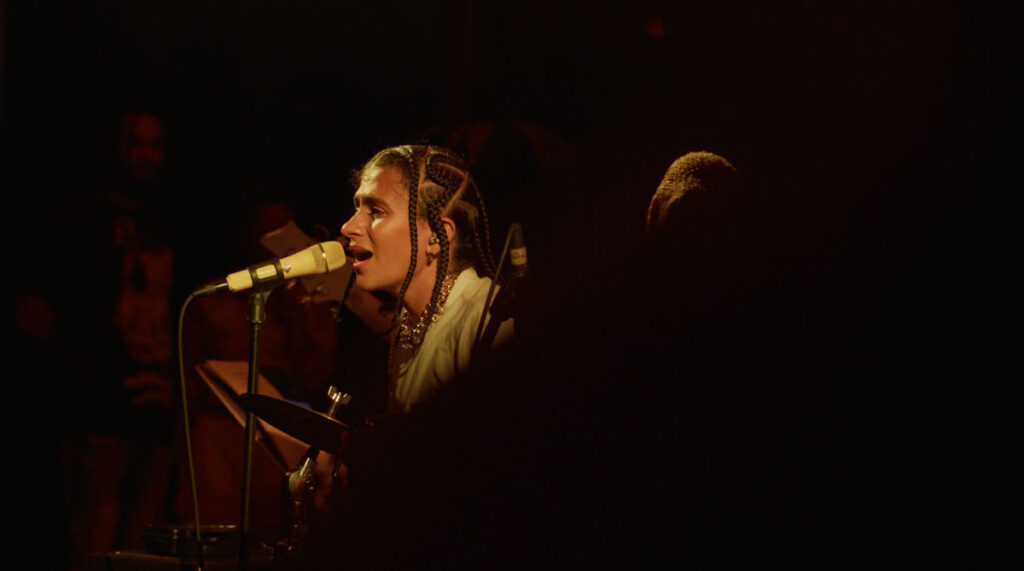
Los Angeles-based artist and activist Kiran Gandhi is a Harvard-educated musician, former drummer for Grammy-nominated artist M.I.A., and TED Fellow. Performing as Madame Gandhi, she is known for her uplifting, percussive electronic music and message of personal power. In her work, she positions herself exactly at the nexus between humanity and nature, art and activism, and awareness and change. L-ISA Immersive audio allows her to deliver both innovative sound design and emotional impact.

Two Sides of the Same Coin
In the latest episode of The Artists of Sound, Madame Gandhi explores how her art is inseparable from her activism. “I believe you must use your art to be in service of something higher”, she says, speaking of the social justice issues that are close to her heart. Climate, gender, and LGBTQIA+ advocacy all feature prominently in her music, live performances, visual work, and speaking events.
“I only do music for activism. Sometimes I get distracted, and I think, oh, I just want to sing about random stuff. And then I’m, like — let somebody else do that. I need to sing about real stuff.”
The pandemic played an important role in her climate-related work. As she started to spend more time outdoors, she became aware of “a sense of connectedness — that my actions here in a city have ramifications on the rest of the planet”. This thought process took root during her time in Stanford’s Music, Science and Technology master’s program in 2022, when she built her first underwater microphone, a hydrophone, and recorded whale sounds in Monterey Bay.
Field recordings have been foundational to her music since. On a trip to the Colombian Amazon, she recorded frogs and insects, whose natural rhythms she used in place of percussion and hi-hats. The arrhythmic songs of birds and her own instrumentation added the harmonies. One of the tracks that emerged, “Amazon Awakening,” begins with the frogs at pre-dawn, leads into a melodic sunrise, and ends on a high note, the awakening.
In compositions like this, the natural world is both Madame Gandhi’s muse and her co-composer.

Crediting Nature: EarthPercent’s Sounds Right initiative
“Amazon Awakening” is one of several Madame Gandhi tracks to feature NATURE in the credits — a royalty mechanism run by EarthPercent’s Sounds Right initiative.
EarthPercent was founded in 2020 by music managers Adam Callan and Hiroki Shirasuka, with Brian Eno as co-founder and patron. It invites artists and the music industry at large to donate a percentage of their income to organizations that address the climate and nature crises, and has so far attracted pledges from over 300 artists and music businesses. Through Sounds Right, it credits nature as a contributing artist on recordings and, in this way, generates royalties for conservation.
Madame Gandhi has collaborated closely with EarthPercent, and several of her tracks, including “In Purpose,” “Let Me Be Water,” and “All in All,” carry the “(feat. NATURE)” credit.
This approach subverts the idea that artists and listeners are somehow entitled to listen to the sounds of the natural world without acknowledging them — or paying for them. It suggests that field recordings in music risk being extractive and exploitative if they’re not used correctly. There’s an ethical obligation to recognize the world of which we are a part, rather than borrow from it freely.


How Immersive Audio Breaks Barriers Between Humans and Nature
Honoring these environments requires a playback ecosystem that moves beyond traditional constraints.
On a recent trip to Antarctica, she gathered up her hydrophones again: “I would take my classroom microphones and record the sounds of glaciers underwater,” she says. “That’s the best sound, and in L-Acoustics L-ISA, the glaciers are going to sound immaculate.”
In her recordings, the glaciers are rich and dramatic. They groan and crack with the resonance of a kick drum, and clang and fizz with the crash of a hi-hat. They’re both substantial and solid, and also fluid and liquid. They drip and trickle, rush and gush. And they’re amplified by the ice into something cavernous and reverberant. The overall effect is of something eerie: the glaciers are alive, even as their creaks signal an irreversible loss.
In “Let Me Be Water (feat. NATURE)”, the title track of her recent 2025 album, Madame Ghandi combines spoken word with these samples. Listening to the song in stereo, the glacial sounds are experienced as texture, a delicate bassline that carries the melody. Listening to it in L-ISA, however, is otherworldly. On a fully spatial system or in an immersive audio live performance, the sounds become the world around us, a space we feel part of. We are bound to the glaciers’ movements.
“Our music lends itself to spatial,” she adds. “All of the different elements really shine in their own right. The quality of the immersion allows you to just let go. It’s a very cathartic experience.”
And this is perhaps why spatial audio music production plays a role in environmental advocacy: through total immersion, it dismantles barriers. It makes us feel as though we are at one with the whales of Monterey Bay; the frogs, insects, and birds of the Colombian Amazon; and the glaciers of the Antarctic. We are a visitor in their world. Any sense of dominion is artificial. The natural world becomes easier to care for when you feel, as Madame Gandhi did so strongly during the pandemic, a sense of connectedness to it.
Madame Gandhi’s work is all about acknowledging this source material and working with it consciously and sustainably. “When we’re creating, it’s really important to cook with fine ingredients,” she explains. “Every time you add, it’s more and more intentional, and it only adds value. And this is where the beauty of human and nature’s interaction can be harmonious.”
This responsibility, of course, isn’t hers alone—nor is it solely up to the other musicians she works alongside and the organizations they support. For the music industry to play its role in environmental awareness and conservation, music lovers, venues, festival designers, production companies, and sound manufacturers all have to play their part. What would happen if everyone started to pay royalties to the natural world on which we depend? What change might be possible then?

Written by: Cassidy Parker
Frequently Asked Questions
Spatial audio creates fully immersive listening environments that dissolve the psychological distance between a listener and the natural world, making it a powerful tool for emotional advocacy and conservation awareness.
Where stereo renders nature sounds as texture, L-ISA places them spatially around the listener, creating the sensation of being physically present in the recorded environment.
Sounds Right is a royalty mechanism that credits NATURE as a contributing artist on recordings that include field recordings. The royalties it generates go to climate and conservation organizations.
Subscribe to Our Newsletter
Get the lastest news and find out about listening events.